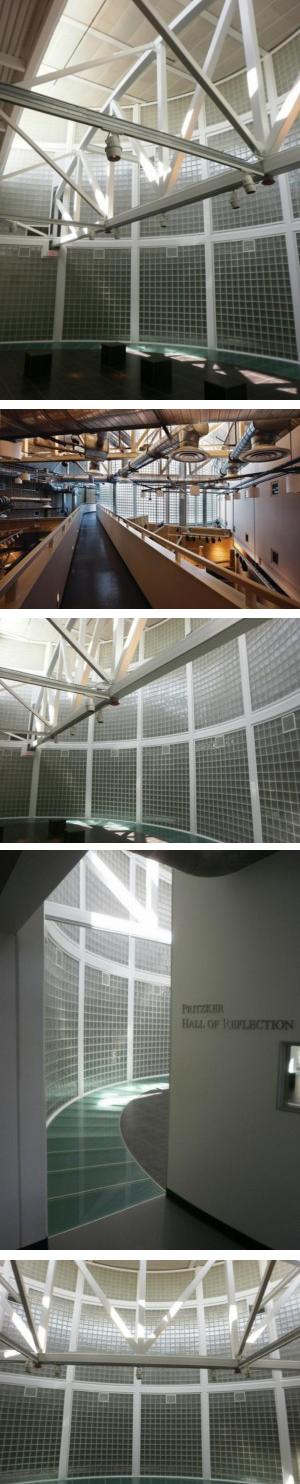
Illinois Holocaust Musuem & Education Center - Skokie, ILThe Illinois Holocaust Museum and Education Center in Skokie, Ill., was designed by the renowned architectural firm of Tigerman McMurray and draws heavily on symbolism and cultural references. The museum consisted of two buildings clad in aluminum panels, hinged at the center, and oriented toward the east and Jerusalem. The first building is finished in somber colors, representing a descent into darkness. The second building, finished in white, represents the visitors' ascent back into light. At the very end of the museum is a cylindrical reflection area overlooking the exhibition space in the second, lighter building. It is in this space that glass block forms the culminating feature, a western-oriented circumferential glass block wall. "I thought about using lexan, fiberglass, a whole list of materials," said Stanley Tigerman, the principal architect for Tigerman McMurray. "But there is no size to them. With glass block, you know it has a size. It has certain inevitability. It was the only material that I could imagine for this." Considering it was the focal point in the reflective, uplifting portion of the journey from darkness to a new beginning, the same careful thought had to be given to the choice of who would install the glass block. The wall was built on a radius with 4,000 glass blocks integrated into visible structural steel tube framework. The glass block needed to be detailed precisely to fit within the dimensions of this steel support system and then elevated over the top of the exhibit areas to represent the ascent of the Holocaust victims. The project’s coordination and dimensioning had to be worked out with the HVAC contractor whose large duct work was also integrated through the steel frame, so the general contractor Bulley & Andrews of Chicago turned to the experts in the glass block installation field, Glass Block of America. "Glass Block of America had done many high profile glass block jobs in the Chicago area, including transit and school work, so it was not a difficult choice," said Patrick O'Bryan, Project Manager for Bulley & Andrews. "We were looking for someone to make sure the dimensioning and detailing were determined well in advance considering the glass had to fit in the unforgiving steel frame. You can't cut steel or glass block and the mortar joints needed to be consistent throughout the whole wall as specified by the designer." When the time came for installation, the work went seamlessly because of the proactive attention to detail by project management teams of Bulley & Andrews and Glass Block of America. "We were able to complete the project in two weeks," said Jeff Boesch, Field Superintendent of Glass Block of America. "Bruce Piecuch of Bulley & Andrews was extremely pleased there was no negative impact on scheduling. Everything went as planned and Piecuch was able to continue with the finishes of the project as scheduled." In the end, glass block met the needs of the architect, and Glass Block of America met the needs of all parties involved to complete the project and make the vision for this museum a reality for many generations to come. Glass Block of America |