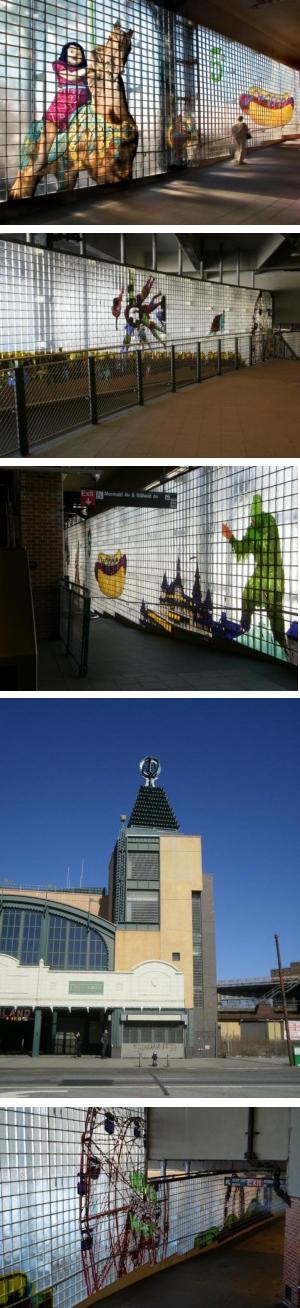
Case StudiesStillwell Ave Station - New York, NY When it came to reconstructing the Stillwell Avenue Terminal at Coney Island Amusement Park in New York City, the Metropolitan Transit Authority (MTA) had several requirements in mind. First, it wanted the reconstruction to have a life span of 50-100 years. It also wanted the structure to incorporate some green building products and natural aspects with the design. Finally, it wanted to include an artistic representation of the area due to an understanding that incorporating cultural art in public areas causes less vandalism and image problems. With these requirements, the MTA’s Arts for Transit representatives and architects turned to Glass Block of America, a 20-year-old business headquartered in Medina, Ohio, who proposed a very unusual solution for the MTA's needs. Glass Block of America made the exterior wall, which is approximately 300 feet long by 17 feet 4 inches high, out of Pittsburgh Corning Corporation's VistaBrik® , 3" thick solid glass block. This in itself is not unusual, as transit projects across the county are using this type of block because of its inherent ability to bring in natural light while still offering enhanced ballistic, impact, and sound transmission characteristics. The unusual nature is how the art was integrated. Famed artist Robert Wilson was commissioned to create a whimsical portrayal of Coney Island, including a 12-foot hotdog with purple mustard, titled "My Coney Island Baby". Glass Block of America then shipped half VistaBrik® , also known as pavers, to Germany to have this painting added to the face of the pavers. "Over in Germany, they incorporated the art on the face of the paver", said Steve Boesch, Vice President of Glass Block of America. "They then laminated another paver to it with a PVB foil, like they use in a windshield of a car when they laminate two pieces of glass together. So now what you have is a three-inch solid piece of glass with art in the center of it, so that people can't scratch it off, they can't get to it." "They used glass melting colors", said Boesch. "It’s not an ink or a dye, but a material that's basically like a liquid glass. They painted silkscreen images onto to the pavers, and then they baked them in a kiln. If you were to use an ink or dye, you really wouldn’t see the light coming through the colors. By using glass melting colors, you are still getting all the light through the block, but you will have brilliant images of colors and very detailed high-definition artwork." After meeting two requirements, the third of creating a 50- to 100-year life span wall with only three-inch glass blocks was tackled. "We used horizontal reinforcement as most applications do, but we also added vertical reinforcement in order to enable us to incorporate large glass block panels without seeing any type of structural steel support," Boesch stated. "In other words, we didn't want to break up the images by having to put steel in, so we used vertical reinforcement in the mortar joints." Also, to limit the amount of water introduced to the wall during the building process, the Glass Block of America team suggested the use of a bonding agent for the mortar joints. "Laticrete 3701 is an acrylic additive that promotes bonding and prohibits moisture penetration," Boesch said. "In the masonry business, we all know that the first thing to kill a masonry wall is water and moisture. We felt it was important to add this product to prevent water penetration on such a large exterior wall." After more than two years of designing, developing, and testing, the curvilinear glass block mural was completed, making it the largest and longest Vistabrik® glass block wall in the country. Glass Block of America |