
Hohmann & Barnard, Inc. 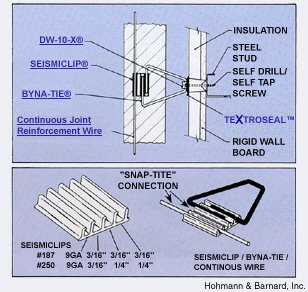 DW-10® SERIES VENEER ANCHORS FOR DRYWALL CONSTRUCTION WITH METAL STUDS
DW-10®-SEISMICLIP® INTERLOCK SYSTEM Reinforced Masonry Veneer Wall Applications Why specify the SEISMICLIP® INTERLOCK SYSTEM?
Architects, owners and contractors desiring to reinforce masonry veneer for either of the above reasons can now specify this positive mechanical system. Horizontal joint reinforcement wire and BYNA-TIE are snapped into SEISMICLIP and fully surrounded by mortar. This allows wire, BYNA-TIE and DW-10 Series Anchor to work as a single unit fastened to the steel stud backup. *CONFORMS TO UBC SEC. 3006 (d) I (i) THE SEISMICLIP*
SEISMICLIPS ARE SOLD ONLY IN CONJUNCTION WITH COMPATIBLE HOHMANN & BARNARD PRODUCTS. The DW-10-X®, BYNA-TIE® and SEISMICLIP® Interlock System have been tested and evaluated for use in Seismic Zones 3 & 4 in accordance with ICBO guidelines. See ICBO Evaluation Service, Inc., Evaluation Report No. 4882 for allowable values and/or conditions of use concerning material presented in this document. CAN. PATENT NO. 1,313,887 |